montage

Doctor of Philosophy in Engineering Physics

rocket

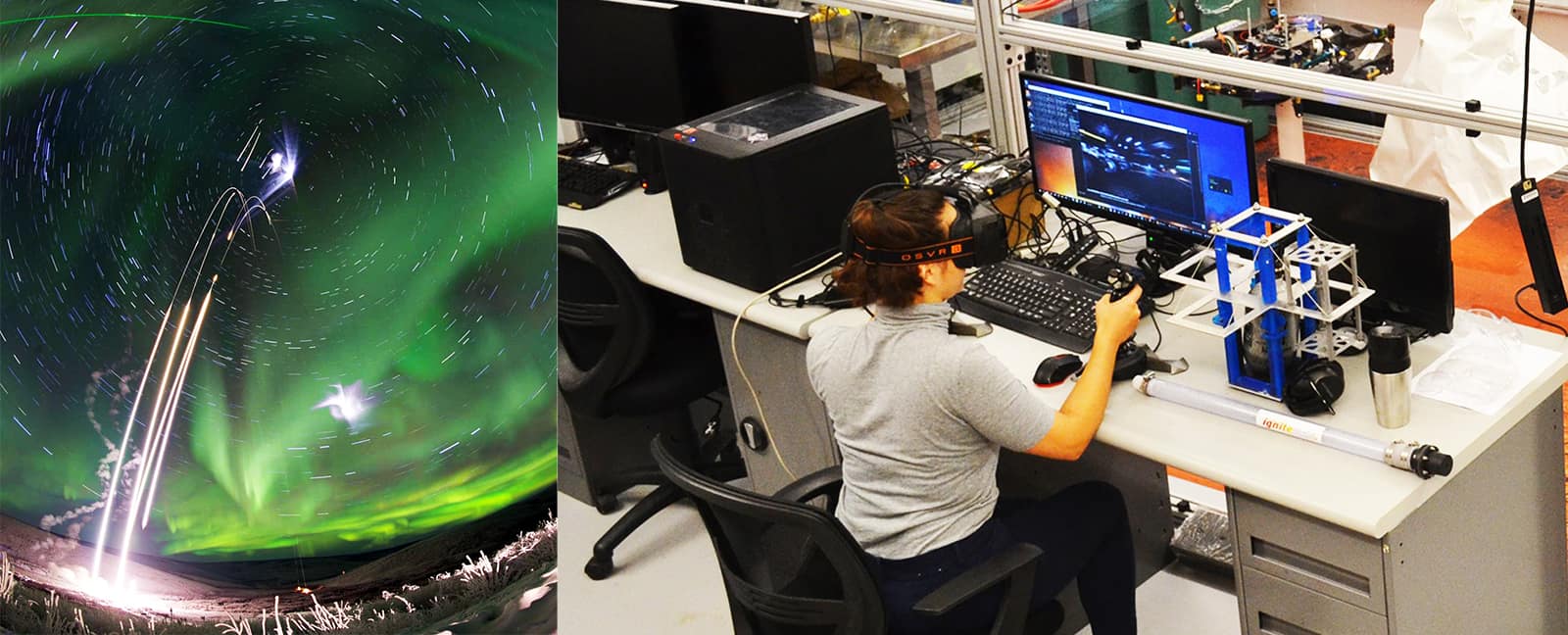
Embry-Riddle rocket payload is launching into space.

The Physical Sciences Department offers a graduate program leading to the Ph.D. degree in cutting-edge areas of engineering physics.

Areas of Research Include:

  • Aeronomy/Upper Atmospheric Physics
  • Space Physics
  • Spacecraft Instrumentation
  • Spacecraft Systems Engineering
  • Spacecraft Power and Thermal Control
  • Dynamics and Control of Aerospace Systems
  • Space Robotics/Autonomous Systems
  • Space Weather
  • Remote Sensing
  • Energy Systems
  • Nanomaterials

The department houses more than 20 faculty members. Assistantships and fellowships are available to well-qualified students.

The deadline for applications is March 15th 2009 for US students and February 15th 2009 for International students. For further information write to:

Graduate Committee
Physical Sciences Department
Embry Riddle Aeronautical University
Daytona Beach, FL 32114
Email: oliveroj@erau.edu
(386) 226-6453

*Embry-Riddle Aeronautical University applied to the Commission on Colleges of the Southern Association of Colleges and Schools (1866 Southern Lane, GA 30033-4097, Telephone 404-679-4501) in September, 2008 to begin awarding degrees at the doctoral level and expects to have a preliminary decision in December, 2008.

Doctor of Philosophy in Engineering Physics

The objective of this Ph.D. program is to provide advanced education and research opportunities to exceptional students by providing a research environment that fosters collaboration, creative thinking, and publishing of findings in nationally recognized journals.

Areas of research emphasis will build upon existing research in the Physical Sciences Department. These include the measurement, theory and modeling of the near-space and space neutral and plasma environment, studies of the Sun and stellar activity, orbital stability and dynamics, engineering related to spacecraft instrumentation and remote sensing measurements, and the design and implementation of electro-optical and radar systems.

ADMISSION

Students may be admitted to the Ph.D. program in Engineering Physics in two different ways:

  1. After completing a B.S. program. Applicants are expected to have a B.S. degree in Physics, Engineering, or a related field (such as Math or Chemistry) for preparation. Only well prepared and highly competitive candidates should apply to enter the Ph.D. program directly from the B.S. program.
  2. After completing an M.S. program. In this case the applicants are expected to have a M.S. degree in Physics, Engineering, or a related field (such as Math or Chemistry). 

Applicants are required to provide formal transcripts, general GRE scores (verbal, quantitative, and analytical writing), three letters of reference, and a personal statement of technical interests, goals, and experience. An international student whose first language is not English must submit a TOEFL score and can be interviewed by phone to assess the spoken English skills. Standards for entry to the Ph.D. program are considerably more rigorous than for the M.S. program. Satisfactory completion of the M.S. program does not guarantee admission to the Ph.D. program.

PROGRAM REQUIREMENTS

Precandidacy Status

Study towards the Ph.D. degree requires a strong background in an area of specialization and an ability to carry out independent research. After being admitted to the Ph.D. program the students acquire the Precandidacy Status. In order to reach the Candidacy Status the students must both:

  1. complete at least 30 hours of required Master's level work, and
  2. pass the Qualifying Exam

The students who were admitted to the Ph.D. Program, having backgrounds different from Engineering Physics, may be required by the admission committee to take specific additional courses during their Precandidacy Status.

During Precandidacy Status in parallel with taking the courses and preparing for the Qualifying Exam the students are encouraged to explore research topics with the Graduate Faculty.

Qualifying Exam and Candidacy

To become a Ph.D. Candidate, a student must demonstrate a high level of competency by passing the Qualifying Exam. The exam is based on the graduate core courses. It will be administered by the Physical Sciences Department Graduate Faculty. The student should take the Qualifying Exam within two years of their initial residency. The students who fail some of the topics of the Qualifying Exam may be allowed to take it once more at the next available opportunity. Only two attempts are allowed.

The PhD Candidate now selects a Thesis Advisor and with his/her assistance forms the Dissertation Committee. This action should be taken within one year of acquiring the Candidacy Status. The candidates should proceed with doctoral research and the preparation and defense of the Dissertation Research Proposal (or Prospectus). 

Dissertation Committee

The committee will have five or six members all of whom must be approved by the Ph.D. Committee. It will be chaired by the student's Thesis Advisor. One committee member will be external to the Ph.D. program. The committee will be charged with monitoring student progress, and examining student performance in their research through their dissertation proposal defense, seminars, their written dissertation, and their dissertation verbal defense.

Residency Requirement

A doctoral student must be enrolled at ERAU for a minimum of two semesters per year. The intent of the residency requirement is to ensure that doctoral students contribute to and benefit from the complete spectrum of educational, professional, and enrichment opportunities provided on the campus of a comprehensive university.

Residency at aerospace industries or at national or international government laboratories, by the agreement and under the supervision of the Research Advisor and registered for dissertation credits is acceptable towards the residency requirement.

Dissertation Research Proposal (or Prospectus)

The purpose of the Dissertation Research Proposal and the proposal defense is to ensure that the student has all of the following: (a) performed an adequate literature search, (b) a deep understanding of their research field, (c) identified a problem that could produce a doctoral-quality contribution(s), and (d) a reasonable plan for how to proceed.

Dissertation Research Proposal Requirements. The candidate must prepare a thesis proposal consisting of:

  • A clear, specific statement of the technical problem and the objectives of the proposed research.
  • A thorough, adequately referenced, summary of previous work done on the problem.
  • A plan for the initial approach to the problem, an outline of the major foreseeable steps to a solution of the problem, an estimate of the time that might be required, and a list of the facilities needed.

The Dissertation Proposal Defense is evaluated by the student's Dissertation Committee and it is chaired by the student's Thesis Advisor.

The thesis proposal and its defense should be successfully completed within a year after being admitted to Candidacy. It is the responsibility of the candidate to bring to the attention of the Dissertation Committee, at some stage within this time period, the need to schedule the Dissertation Proposal Defense. Once the Dissertation Committee has agreed that the Dissertation Proposal Defense should be scheduled, it is the responsibility of the candidate to schedule a mutually convenient date with his/her Committee, and to coordinate with the department staff.

Dissertation

To obtain a doctoral degree, a student must complete a dissertation on a research topic in his or her area of specialization. To be acceptable it must be an original research achievement, constitute a significant contribution to knowledge, and display a substantial scholarly effort on the part of the student.

Dissertation Defense

The defense will consist of two components: a public presentation, followed by an examination by the Dissertation Committee, in closed session. The public presentation is an opportunity for the Ph.D. Candidate to summarize his or her research in seminar/colloquium format. Afterwards, the dissertation content will be discussed and questioned, by the Committee, in a closed session. The Candidate is then dismissed and the Committee completes their evaluation.

Course Work

  • A minimum of 90 hours beyond the Bachelor's degree
  • A minimum of 60 hours beyond the Master's degree, distributed as follows:
  • 12 hours minimum at the 700 level or higher
  • 0-18 hours at the 500-700 level
  • 30 to 48 hours of dissertation research
  • Total courses + research = 60 hours

From the following list of new 700-level courses, students will choose a minimum of two from the first five (EP 701 – EP 705) and a minimum of two from the second five (EP 706 – EP 710).

Core Courses
Course Title Credit
EP 701 Electrodynamics 3
EP 702 Stochastic Processes 3
EP 703 Optimal Dynamical Systems 3
EP 704 Geophysical Fluid Dynamics 3
EP 705 Electro-optical Engineering 3
EP 706 Computational Atmospheric Dynamics 3
EP 707 Nonlinear Dynamical Control Systems 3
EP 708 Variable Structure Control Systems 3
EP 709 Remote Sensing: Active and Passive 3
EP 710 Space Plasma Physics 3
EP 701 Electrodynamics:
This is a graduate course on static and dynamic properties of electromagnetic fields. The objective of the course is to develop advanced concepts in electrostatics, magnetostatics, and electrodynamics. This course also emphasizes various mathematical techniques for solving practical electromagnetic problems encountered in space plasma, antennas, propagation, and scattering using Maxwell's equations.
EP 702 Stochastic Processes:
This course is an advanced graduate course in stochastic processes and their applications in physics and engineering. The course covers rigorously continuous-time and discrete-time random processes and principles of optimal estimation. It focuses on the following topics: foundations of the stochastic processes theory based on probability space and -algebras of events, Gaussian processes, Markov processes, Brownian motion, and multidimensional Wiener process and their relation with the notion of "white noise", stochastic Ito integrals and stochastic differential equations, stationary processes and their spectral properties, conditional expectations and optimal estimation techniques, Kalman filtering and time-series.
EP 703 Optimal Dynamical Systems:
This course is an advanced graduate course in optimal control systems. The course covers the principles of optimal control. It focuses on the following topics: classical calculus of variations, LQR and LQG methods, Pontryagin maximum principle, time-optimal control. The course is structured to emphasize some of the recent research activity in optimal dynamical systems analysis and control.
EP 704 Geophysical Fluid Dynamics:
This is the first graduate course in atmospheric dynamics. The thermodynamics of fluids and conservation laws are introduced, which lead to the Navier-Stokes equations describing fluid flow. Effects of rotation on fluids is described. Wave motions occurring in the atmosphere and oceans are described, and include gravity waves, Rossby waves and Kelvin waves, as well as tidal motions. Instability processes, some triggered by waves, are discussed, and the cascade of energy to smaller scales through turbulence is described. Global scale "mean" motions (winds and Hadley cells) are discussed. The dissipative effects of molecular diffusion in rarefied gases is also described.
EP 705 Electro-Optical Engineering:
This course investigates the basic aspects of digital and analog fiber-optics communication systems. Topics include sources and receivers, optical fibers and their propagation characteristics, and optical fiber systems. The characteristics of lasers, optical amplifiers, and detectors and noise will be investigated, and systems design of fiber optic communication systems will be addressed. Quantitative development of electro-optical remote-sensing systems such as LIDARs, Hyper Spectral Imaging, Multi-directional high throughput temperature imagers, very low light level white light and monochromatic visible and infrared-red all-sky cameras. New high quantum efficiency, low thermal and read out noise detectors. Compact and rugged zed space-borne facilities and integrated multi-instrument observing systems. Digital processing and analyses of various images recorded with satellite instrumentation as well as ground-based recording of all-sky monochromatic and wide band pass images. Application of all the above to medical, drug, hazardous chemical testing and detection as well as to industrial and space exploration needs.
EP 706 Computational Atmospheric Dynamics:
This is a second graduate course in atmospheric dynamics. Here we emphasize the numerical solution of the governing fluid equations for various types of fluid flows. Various numerical methods and their associated limitations are discussed. Comparisons between real observations and simulations will be made wherever possible. Students will gain experience running large simulation code on a supercomputer. In addition to exams students will be required to complete a hands-on project.
EP 707 Nonlinear Dynamical Control Systems:
This course is a second graduate course in nonlinear dynamical control systems, organized into three major parts: differential geometric nonlinear control, advanced topics in feedback linearization, and input-output and advanced stability analysis. The course is structured to emphasize some of the recent research activity in nonlinear dynamical systems analysis and control. It uses concepts from differential geometry, however the course is self contained in that the necessary mathematics will be taught as part of the course.
EP 708 Variable Structure Control Systems:
This course is an advanced graduate course in variable structure control systems. The course covers the principles of variable structure control both mathematical theory and applications especially in aerospace and automotive areas. It focuses on the following topics: systems models in the form of differential equations with discontinuous functions, sliding mode description and sliding mode control design methods, sliding mode observers design. The course is structured to emphasize some of the recent research activity in variable structure dynamical systems analysis and control.
EP 709 Remote Sensing: Active and Passive:
This course introduces students to concepts in remote sensing in the microwave and RF bands. The course will cover the fundamentals of radar and passive remote sensing. This includes the underlying physics of scattering and radiative transfer, analytical techniques, system designs, and examples illustrating the use of radiometer and radar as tools for monitoring the natural environment. The course will provide a systems perspective to remote sensing instrument design. The students will obtain the knowledge and ability to perform basic systems engineering calculations, evaluate tradeoffs and evaluate advanced systems.
EP 710 Space Plasma Physics:
This course is a graduate course in advanced plasma physics and its space applications. A strong background knowledge of electrodynamics, and a previous introductory course (at the undergraduate level) in plasma physics is strongly recommended. It will start from the microscopic fundamentals and then derive useful approximations such as Vlasov theory, two-fluid theory, and magnetohydrodynamics. Waves and instabilities in each of these descriptions will be investigated. Applications to the space environment will form a core component of this course.